Friday, January 18, 2013

Improve your Golf Swing and Avoid Injury With These Helpful Tips


Five Exercises to Avoid Injury and Improve your Golf Swing

As the cold air breaks this week and returns to nicer golf weather, the courses will be filled with eager golfers looking to take advantage.  But what can you do to avoid that dreaded injury that could sideline you during golf’s busiest and nicest season?  Further, what easy exercises can you do to strengthen your game?

Ryann Roberts, DPT
To answer these questions, we have enlisted Erica Dechowitz, future professional golfer and Ryann Roberts, DPT, AZOPT owner and physical therapist.  Erica is currently rehabbing arthroscopic knee surgery in her right knee with Ryann after a fluke shot in a bunker caused her knee to buckle improperly.  This golf-related injury could have happened to any of us, and probably would have ended worse for most of us.  Being in the best shape of her life at the time of her injury prevented Erica from a more serious injury, which would have affected her goal of qualifying for the U.S. Amateur this summer.

Erica Dechowitz
Your core – simply, your body minus your legs and arms - is the most important part of a strong golf game.  The power in your swing comes from your core and hips.  The ability to balance and shift your weight correctly through your swing comes from your core.  The strength to get through playing 18 holes of golf comes from your core.  According to Erica, “as long as you’re stable in the core, you can swing as hard as you want, and the ball will go straight.” 

After your core, the next important parts of your body are your quadriceps, hamstrings, and shoulders.  But as Erica told us, “you cannot just go to the gym and pick up weights without knowing what muscles you are working and why.  You will risk future injury or a worse golf game.”

With the help of Erica and Ryann, we are able to provide you with these five exercises that will strengthen the important parts of your body to help you avoid injury while hopefully improving your golf swing.  Try them, and let us know what you think in the comments section of this post!

Exercise #1 – Front Plank
Equipment Needed: None
Muscles Trained: This is an isometric (static) core exercise that will strengthen the abdominals, back, and shoulders.
Description: Put your body in a push up position with your body’s weight on your forearms, elbows, and toes and hold for 5 to 30 seconds.  There are many variations such as the side plank and reverse plank, which involve a higher degree of difficulty.  Make sure your butt stays neutral and does not sag below your hips or rise above your hips and that your core stays contracted throughout the exercise.
Reps:  Perform 5-10 daily
How will this translate into your golf game?  “The plank is a basic core strengthener that will help improve your balance during your swing,” says Erica.


Exercise #2 – Hip Flexor Stretches
Equipment Needed: Towel, if needed
Muscles Trained:  Your hip flexors, located on your upper thighs, just below your hipbones, which allow you to lift your knees and bend at the waist.
Description:  Begin by kneeling on your right knee (use a towel to cushion your kneecap, if necessary).  Place your left foot in front of you, bend that knee, and place your left hand on your left leg for stability.  Your right hand should be placed on your right hip, keeping you from bending at the waist.  Make sure your back is straight and your core is tight.  Sink, as if trying to touch your groin to your front heel, being careful not to extend your knee over your toe.  You should feel the stretch in your right hip flexor.  Hold this stretch for 30 seconds, and then switch legs and repeat.
Reps: 3-4 reps with each leg, 2 or 3 times per day
How will this translate into your golf game?  According to Ryann, “this stretch will reduce stress on your back and allow you to make complete turns while maintaining your stable base.”


Exercise #3 – Corner Pectoral Stretch
Equipment Needed: Two walls, usually behind a closed door
Muscles Trained:  This stretch works your pectoral (chest) muscles.  By altering the position of your arms, the stretch will focus on different parts of the chest muscles.
Description:  Stand facing the corner with your elbows at shoulder height.  Place your forearms, elbows, and hands against the wall with your elbow at a 90 degree angle.  Lean inward and hold for 15 seconds.
Reps:  6-10 reps daily
How will this translate into your golf game?  “This stretch helps to set your shoulders in the proper position giving you better shoulder mobility and rotation,” says Ryann.


Exercise #4 – Side Lying Shoulder External Rotations
Equipment Needed: none up to light weights
Muscles Trained:  This exercise promotes scapular (shoulder blade) movement and stability and reduces the risk of shoulder injuries.  Also strengthens the rotator cuff and the posterior deltoid.
Description:  With either no weight or a light dumbbell, lie on your side with the dumbbell in the hand of your upper arm.  Position your upper arm’s elbow against your ribs to avoid any other movement except external rotation.  Simply rotate your arm through the full range of motion, keeping your scapula (shoulder blade) retracted throughout the entire exercise.  Do not allow your elbow of the upper arm to drift away from your body.
Reps:  2 or 3 sets of 20 reps each arm daily
How will this translate into your golf game?  “Since the shoulder is a high mobility joint, this exercise will give you better shoulder stability improving the strength that will help you achieve better posture and scapular (shoulder blade) control.  Ultimately, this will assist your follow through and help with more consistent ball striking,” says Ryann.


Exercise #5 – Russian Twists
Equipment Needed: Medicine Ball, Bosu Ball
Muscles Trained: Core
Description: Stand with your feet shoulder width apart.  Hold a medicine ball with both hands and arms only slight bent.  Swing the ball over to the right hip and forcefully swing ball forward and around to your left side.  Reverse back in the opposite direction.  Keep your core tight to maximize proper usage of all muscles.  Once you become more advanced, you can do this exercise while balancing on a Bosu Ball.
Reps:  2-3 sets of 30 seconds daily
How will this translate into your golf game?  This exercise is Erica’s favorite.  She prefers this exercise on two Bosu balls flipped over with a personal trainer throwing the ball to her (for a better description, Tweet Erica directly @EricaDech).  Erica tell us “this exercise will strengthen your core, give you better endurance, and improve your ability to wind up and release through your swing for maximum speed and better ball striking.”


Erica Dechowitz has been golfing competitively since she was 15 years old, but has been on the golf course since she was a toddler.  After growing up in Pennsylvania and attending Kutztown University, Erica moved to Arizona in 2011 to train year-round.  She currently is working towards qualifying for the U.S. Amateur in August.  Erica’s favorite golf drill is to hit 5 balls with a club, and then hit another 5 balls with the same club, but with her eyes closed.  This drill forces her to really focus on her muscle memory and how her body feels throughout the swing.  Erica’s favorite golf course is Bulle Rock Golf Course in Maryland, which she golfed with her dad during a road trip after her high school graduation.  Keep up with Erica on Twitter @EricaDech.

Wednesday, January 16, 2013

Follow AZOPT's Client Mr. A Through Total Shoulder Replacement Surgery

Following AZOPT's Client Through Total Shoulder Replacement Surgery - Entry #1
January 16, 2013
  
Shoulder_Anatomy
The Core Institute
The shoulder is the most mobile joint in the body. It plays a major role in positioning your arm and hand through space. Most of us take for granted our shoulder movements throughout a normal day’s activities. Think about all of the activities that require lifting your arm – washing your hair, brushing your teeth, drinking a cup of coffee or water, driving a car, carrying groceries – the list can go on. That’s not to mention an active lifestyle that includes golf, pickle ball, or any other type of exercise. 

But what happens when the pain is so bad that the simplest daily activities cause the most severe pain? What happens when you can’t even wash your own back, or worse, clean up after using the toilet? This was the life of AZOPT client, Mr. A. Mr. A was faced with a choice – live with a shoulder overloaded with arthritis that caused pain in every movement or have total shoulder replacement surgery. 

This blog series, which we will update every 2 to 4 weeks, will follow Mr. A through his rehabilitation from total shoulder arthroplasty (TSA) of his left arm, and provide an accurate account of Mr. A's experiences. Interestingly, Mr. A came to Arizona Orthopedic Physical Therapy following TSA of his right shoulder. A natural left hander, Mr. A decided after successful rehab on his right shoulder to move forward with TSA of his left shoulder. His knowledge and experiences after having TSA on one shoulder will give us more perspective as he rehabs the other shoulder. 

-------------------------------------------------------

Surgery is always a last option, only to be considered after non-surgical treatments such as physical therapy and activity modification fail to provide sufficient relief. The clear path for Mr. A was TSA on his right shoulder in April, 2012. After at least ten years of worsening pain forced him to need help getting up and down out of bed and in and out of a chair, the ‘straw that broke the camel’s back’ was during a theatre production of Smokey Joe’s Café. Extensive choreography required the actors to raise their arms above their heads during various scenes. Mr. A was already limited driving his car and helping his wife around the house with cleaning and heavy lifting, but now he was being scolded by the director for not performing the choreography accurately, a move that Mr. A could not physically accomplish. 

Mr A, 73 years young, was an active young man. He is a retired auto worker who used to lift weights, golf, and swim. In his own words, “I am not a sit around type of guy, but my shoulders have forced me into this kind of lifestyle.” His main goal through both surgeries is to eliminate pain and increase his range of motion and functional strength allowing him to return to all activities without restrictions. Prior to his first surgery, he had full functional use of his shoulder, but did have decreased range of motion, decreased strength, and increased pain with activity. 

According to The Core Institute, “shoulder replacement surgery essentially involves replacement of the worn out joint surfaces. There are several shoulder replacement implant types which are designed to address different patient needs, anatomy, and arthritis type. Also, there are a myriad of factors that your surgeon will weigh in order to select the correct type of replacement which is best for your shoulder. What works well for one patient may not be the best choice for your shoulder.” (The Core Institute. Total Shoulder Replacement Surgery. Retrieved from http://www.thecoreinstitute.com/total-shoulder-replacement-surgery.html).

AZOPT did not begin working with Mr. A until after his right shoulder TSA. Therefore, we can only provide pre-surgery measurements of his left shoulder and post-surgery measurements of his right shoulder. Mr. A first arrived at AZOPT May 10, 2012, following his first surgery April 26, 2012. 

His range of motion measurements were as follows: 


Left
Right
Flexion
150°

60° with pain
Abduction
111°

External Rotation
72°

Internal Rotation
60°


After 5 months (or 59 visits) of physical therapy, Mr. A’s range of motion measurements were as follows: 


Left
Right
Flexion
150°
142°
Abduction
111°
120°
External Rotation
72°
73°
Internal Rotation
60°
65°


http://www.nursing411.com
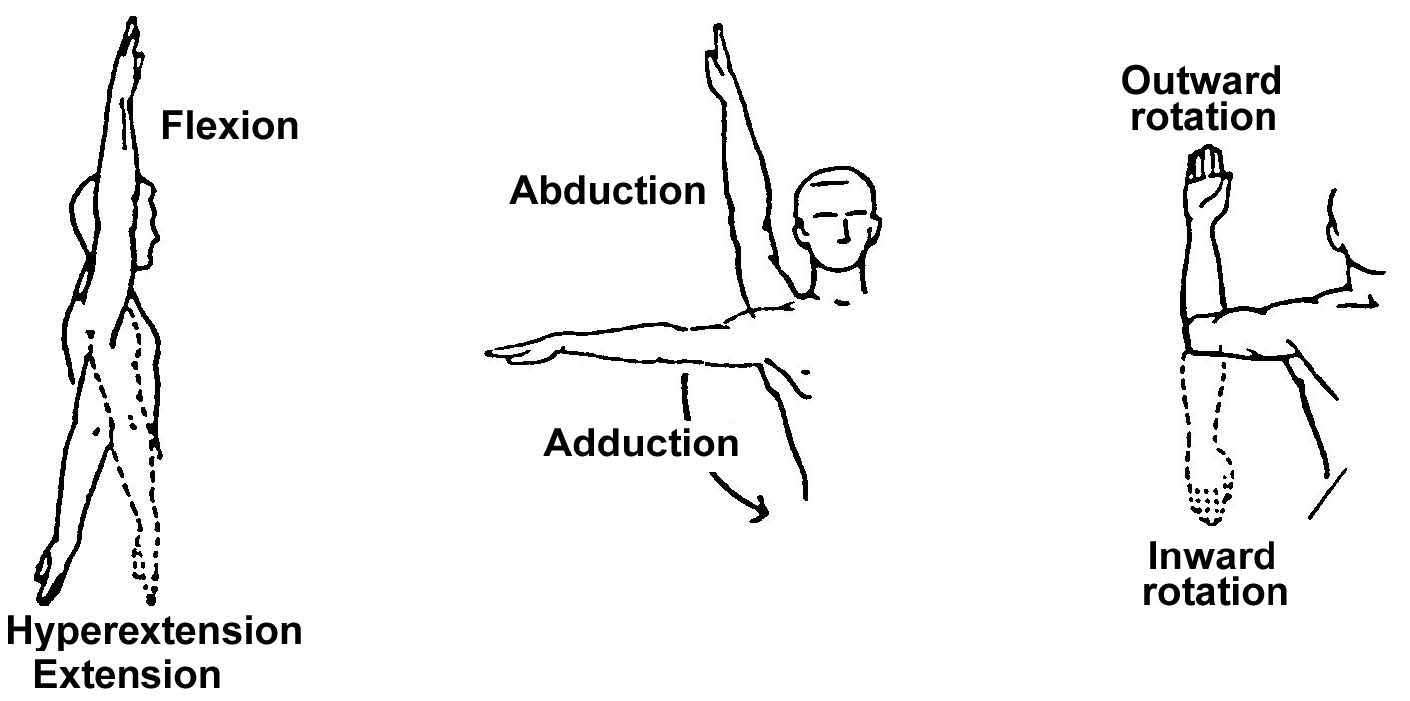
Flexion is the range of motion (ROM) measurement from lifting your arm straight forward from your hip to above your head. Abduction is the ROM measurement from lifting your arm straight from your hip out to the side and above your head. External rotation is the ROM measurement with your elbow at 90 degree, rotating your hand outward. Internal rotation is the ROM measurement with your elbow at 90 degrees, rotating your hand inward. These measurements translate directly to functional activities – washing your hair, tucking in your shirt in the back, putting away dishes in the cupboard. Generally speaking, a healthy range of motion would be 160 degrees flexion, 170 degrees abduction, and 90 degrees external and internal, although this does vary person to person. 

On September 28, 2012, Mr. A was discharged, knowing he would be having TSRS on his left shoulder, and would be back in physical therapy to rehabilitate both shoulders following surgery. Prior to his second surgery, Mr. A stated his left shoulder currently had pain levels at a 7 out of 10, with 0 being no pain and 10 being the highest amount of pain. He felt his right shoulder was approximately 80% rehabilitated. His sleep patterns cause him the most pain, as he changes sides constantly throughout his sleep, waking up two to three times each night. 

Mr. A had TSA surgery on his left shoulder on Thursday, January 10. Surgery was done by Dr. Jason Scalise, from The Core Institute. AZOPT Physical Therapist Doug Lehman, PT, who will be Mr. A’s therapist, watched the entire surgery over the shoulder of Dr. Scalise. Check out the next entry, which will discuss the surgery, the immediate care following the surgery, and the rehabilitation plan moving forward. 

We would like to hear from you: 
  1. What would you like to know about this procedure and the rehabilitation process? 
  2. Which of your daily activities are you experiencing pain? 
  3. How is pain affecting what you would like to accomplish in your day?

Tuesday, January 8, 2013

Outdoor Activities That Will Engage the Whole Family!


Outdoor Activities That Will Engage the Whole Family!
By Nichole Hagerty

The unbearable heat has passed us, and cooler, nice weather is here!  What a perfect time to engage our children with fun, outdoor family activities.  I have put together a list of activities that will help improve gross motor skills while having fun in your front or back yard!  A quick trip to a local park will increase the number of activities your family can enjoy.  So take a look at our ideas, head outdoors with your children, and enjoy the weather!

This is just a sampling of games and activities, but we know there are a lot of other ideas out there.  We’d love to hear from you.  Leave us your ideas or fun activities in the comments section below! 

Follow the Leader 
These games not only challenge coordination and balance, but also listening skills and following directions.  Here is a list of some of my favorite childhood games:
  • Simon Says (stand on one foot, touch your toes, jump 5 times - the opportunities are endless)   
  • Red light / Green light (quick start and stop reaction times)
  • Ring around the rosy (fun and following directions)
  • Mother May I (take 10 steps forward, 2 hops, 5 steps to the left - the first person to the “mother” wins!)
  • Hide and Seek 
Play Hopscotch
Hopscotch is great for balance, strength, and coordination.  Jumping on one foot will work the core muscles.  Straddle jumping will improve strength and conditioning.  In fact, hopping may improve "overall lower extremity mobility given the different movement planes (forward-back, sideways, and rotational)," says Fabio Comana, MA, MS, an exercise physiologist for the American Council on Exercise.  You don’t just have to make a basic hopscotch; you can make a variety of boxes.  You can jump through with two feet in the box, or out of the box.  You can jump on 1 foot the whole way down. Work to the ability of yourself and your child.

Create your own Obstacle course 
This, too, will improve overall strength and conditioning.  Walk along the edge of your driveway, or a line on the sidewalk.  Jump over cracks, run around a tree or cactus (be careful not to touch it!) kick a ball in a goal, climb under the bush, and jump over a small/large rock - make it up as you go.  You can measure results and improvement by timing yourself, your kids, and your neighbor’s kids.  Most importantly, have fun! 

Go for a bike ride 
With younger children who are unable to pedal a bicycle, I recommend a tricycle.  A bicycle with training wheels helps only with the balance of the bike.  A tricycle’s pedals are attached to the front wheel, which will increase motor memory and learning when you push the tricycle.  As your child grows and is able to push the peddles on their own, it becomes similar to riding a bike.  Your child will now have the motor memory and motor planning to perform this skill, allowing the child to move to a bicycle with training wheels.  Riding a bike is an excellent, lifelong physical activity that most children love to learn how to do. 

Play Catch/Kick a ball
Little boys love playing ball with their fathers, but did you know little girls do, too.  Playing catch or kicking a ball works on foot-eye or hand-eye coordination.  These coordination skills will show in a variety of school tasks, such as handwriting.  You can start this activity at a young age by rolling a ball back and forth with your child.  Eventually, you will progress to bouncing a ball back and forth.  Then work on throwing and catching.  Start with a playground-sized ball and progressively work towards a tennis/baseball-sized ball.  When kicking a ball, start with a stopped ball, progress to kicking a moving ball, and finally, moving while kicking a moving ball. 

Go to the park 
There are a ton of fun activities at a park for you and your family.  These activities will allow your child to play, but at the same time work on strengthening throughout the core and extremities, along with vestibular reflexes.  Work on climbing ladders, going down slides, swinging, and walking across and through unstable surfaces.  All these activities work on many of the tasks we like to see kids able to perform when they come into therapy. 

Other ideas for you and your child

  • Walk through the zoo
  • Go for a hike
  • Go to Encanto Park
  • Go on “treasure hunts”
  • Go Geocaching
  • As the temperature rises, go to a splash pad

All of these activities improve basic gross motor developmental skills.  Just as important, your child and you will be outside and active!  Most importantly, they allow you all to have fun!!!

I realize this is just a small sampling of games and activities.  We know there are a lot of other ideas out there.  We’d love to hear from you.  What activities do you enjoy outdoors with your children?

Thursday, January 3, 2013

Beginning and Following Through
With Better Fitness This New Year

By Doug Lehman, Physical Therapist 

It’s no surprise the most popular New Year’s Resolution is to get in better shape.  It’s also no surprise that this resolution ends in failure more times than success.  But how can you succeed with this resolution?  What are the keys to getting started, and more importantly, maintaining that focus throughout the year to stay in shape?

I have compiled a list of a few tips and ideas that will help you, but we would like to hear from you in the comments section below.  Tell us what you will be doing in 2013 to challenge yourself by getting in shape AND what helps you keep with it!
  • Pick an activity you enjoy
    When choosing a way to exercise, find an activity you will enjoy.  By liking what you do, you will increase your chances that you will stick with that activity.  For example, my goal is to complete 30 minutes of cardio exercise three days per week.  I do not enjoy running, especially indoors on a treadmill.  If my workout plan was 30 minutes on a treadmill, my likelihood of following through is low.  However, I do enjoy basketball, and am more likely to follow through with my exercise plan by finding a league to join.
  • Find a workout partner
    Often times it is easier to exercise in a group or with a partner, so if possible choose something you don’t have to do alone.  Having that accountability partner will help you keep your commitment on days when you can’t find your own motivation.
  • Don’t bite off more than you can chew
    To start off, you need to start – somewhere.  Rome was not built in one day, and your goal cannot be to run a marathon tomorrow, especially if you have not exercised in months or even years.  If the last time you lifted weights was ten years ago, chances are you are not going to be able to lift the same amount.  This is how injuries occur, and injuries will ultimately delay or end your resolution.  The best advice is to keep your initial workouts simple and short.  If you are starting to run, start with a half mile alternating running with walking.  If you want to lift weights, start with very low weights and work your way up.  If necessary, consult your physician or Physical Therapist prior to starting an advanced exercise program.
  • Show up
    You can hear the excuses begin piling up in your head already – “I’ll start tomorrow.” “One day off isn’t going to hurt.” “I just can’t find the time.” The list can go on and on, but the reality is, doing something is always better than doing nothing.  If you can’t make it to the gym, there are plenty of exercises you can do at home.  If twenty minutes is all you can spare – that’s great!  Even if you had to break it up into two, ten minute workouts, morning and night.  On those days when you think you just can’t, you just can’t, whether you’re at a gym, a class, or at home, put in ten minutes, five minutes – do something!
  • Be patient
    Whether your goal is to get in shape, play a new sport, lose weight, or just feel better, remember that it takes time and dedication to reach your goal.  There is no quick answer.  Don’t get discouraged.  If you haven’t met your goal in a few weeks, a month or longer, don’t worry, you’ll get there; just keep working.  The best way to get in shape and stay in shape is make regular exercise part of your lifestyle from now on.  Don’t think that using a fad diet or exercise program for a short period of time will get the job done.
  • Change your Diet
    Speaking of diets, going leaner and greener is always a good idea! 
These tips should help you get started this new year!  Let us know which of the above is working for you, and we would love to hear your results in the comments section below!